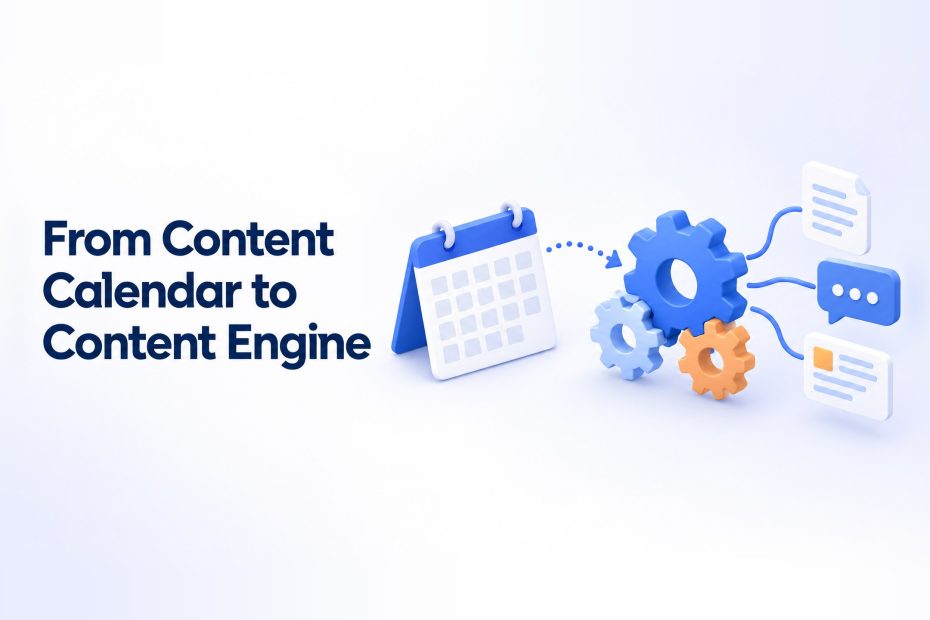
Most marketing teams have a content calendar. It’s colour coded, it’s full, and it gets everyone publishing on time. And yet, when leadership asks what all that content is actually doing for the business, the answer is often a shrug and a slide full of impressions.
The problem isn’t the calendar. A calendar is a scheduling tool. It tells you when to publish, not why. What most teams need is a content engine: a system where every piece has a job, connects to the next, and keeps producing value long after it goes live.
Here’s how to make that shift.
Calendar thinking vs engine thinking
The difference is easier to see side by side.
| Content calendar | Content engine |
|---|---|
| Starts with dates and slots to fill | Starts with buyer questions and business goals |
| Each piece stands alone | Pieces link together and feed each other |
| Success = published on time | Success = traffic, leads and sales conversations |
| Content is used once, then forgotten | Content is repurposed, updated and reused |
| Sales rarely uses it | Sales uses it in real conversations |
If most of your team’s habits sit in the left column, you’re not doing anything wrong. You’re just running a schedule instead of a system.
Step 1: Give every piece of content a job
Before anything goes on the calendar, ask one question: what is this supposed to do?
A useful piece of content usually has one of these jobs:
- Get found: rank in search for a question your buyers ask
- Build trust: show expertise or proof that makes buyers believe you
- Convert: move a reader to take the next step, like downloading a guide or booking a call
- Enable sales: help your sales team answer an objection or explain value
If you can’t name the job, it probably shouldn’t be made. This one habit cuts a surprising amount of “we need something for Tuesday” content.
We’ve written about why so much content misses the mark in Why Most B2B Content Gets Ignored, and What to Create Instead.
Step 2: Build around pillars, not random topics
An engine needs structure. The simplest way to get it is with content pillars: a handful of big topics your business genuinely owns, each supported by smaller pieces that answer specific questions.
For example, a pillar on “lead generation for B2B” might be supported by posts on landing pages, lead magnets, email nurturing and lead scoring. Each smaller post links back to the pillar, and the pillar links out to each smaller post.
This does two things. It helps search engines understand what you’re an authority on, and it gives readers a natural path to keep learning from you instead of bouncing after one article.
If you’re not sure which topics your buyers care about most, start with the keywords your buyers are actually searching for.
Step 3: Create once, use many times
This is the part that makes an engine efficient. One strong core piece, like an in depth guide, a webinar or an original insight, can become:
- Three or four LinkedIn posts, each pulling out one idea
- A short email series for your nurture list
- A carousel or simple infographic
- Talking points or a one page summary for your sales team
- A short video clip for social
- An FAQ section on a relevant service page
You do the hard thinking once, then reshape it for each channel. Your audience sees a consistent message in different formats, and your team stops starting from a blank page every week.
Step 4: Connect content to the buyer’s journey
Content that works harder meets people where they are. A useful check is to map your existing content against three stages:
- Awareness: the buyer is noticing a problem
- Consideration: they’re weighing ways to solve it
- Decision: they’re choosing who to work with
Most teams find a pile of awareness content and very little for the later stages. That’s often why traffic grows but leads don’t. Filling the gaps, especially with comparison pages, FAQs, proof and clear offers, usually has a faster impact than publishing yet another top of funnel post.
Step 5: Bring sales into the loop
Your sales team hears your buyers’ real questions every day. That makes them one of your best sources of content ideas, and one of the best places for content to earn its keep.
Try this:
- Ask sales for the five questions they answer most often
- Turn each answer into a short article or one pager
- Store everything in one place sales can actually find
- Check back each quarter: what are they using, and what’s missing?
When sales starts sending your content to prospects, you know the engine is working.
Step 6: Refresh before you create
New content gets all the attention, but some of your biggest wins may be sitting in old posts. Updating an article that already ranks on page two, or one that used to bring in leads, is often faster and more effective than writing something new.
Once a quarter, look at:
- Posts with steady traffic but no conversions (add a better next step)
- Posts that dropped in rankings (update facts, examples and structure)
- Posts that overlap (merge them into one stronger piece)
How to measure whether your content engine is working
Skip vanity metrics and track signals that connect to the business:
- Leads generated by each piece of content
- How often sales shares content with prospects
- Organic traffic to pillar pages and their supporting posts
- Content that appears in the history of deals you actually won
If a piece isn’t pulling its weight after a fair amount of time, improve it, merge it or retire it. An engine runs best when it’s well maintained.
Turn your calendar into something that compounds
You don’t need to produce more content to get better results. You need each piece to do more. That’s the real shift from calendar to engine.
Digital Friks helps teams build content strategies where every piece has a purpose, connects to the buyer’s journey and supports sales. If your content feels busy but not productive, let’s change that.