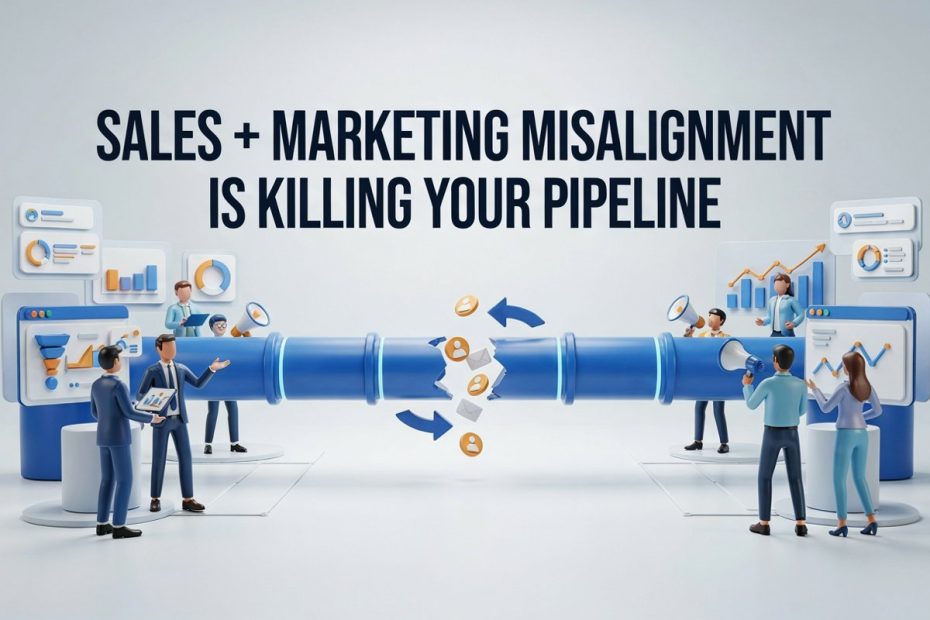
When sales and marketing teams work toward different goals, the pipeline starts to suffer. Marketing may focus on bringing in more leads, while sales may complain that those leads are not ready to buy. As a result, good prospects can slip away before they ever become customers. This is why sales and marketing alignment matters for every B2B company that wants steady growth.
The problem often starts with small gaps. Sales may not share enough feedback about lead quality. Marketing may not know which content helps sales close deals. Teams may also use different data, targets, and views of the buyer journey. Over time, these gaps create slow lead handoffs, poor follow-up, missed sales chances, and weak pipeline growth. The good news is that companies can fix these issues with clear goals, better communication, and shared data.
What Sales and Marketing Misalignment Really Means
Sales and marketing misalignment happens when both teams work toward revenue but do not work together in a clear way. They may have different goals, use different data, or follow separate processes.
Marketing often focuses on traffic, leads, content, and campaign results. Sales usually focuses on conversations, meetings, deals, and revenue. Both areas matter. However, problems arise when teams treat these goals as separate.
For example, marketing may report that a campaign brought 500 leads. Sales may say that only 20 of those leads were useful. Both teams may believe they did their job. Yet the business still has a pipeline problem.
The real issue is not always lead volume. It can be the lack of a shared process.
Why This Gap Hurts the Pipeline
A pipeline depends on several steps working together. Marketing brings attention and leads. Sales turns qualified leads into conversations and opportunities. Both teams need to support the buyer at each stage.
When the process breaks, leads can sit without follow-up. Sales reps may spend time on poor-fit prospects. Marketing may keep sending leads that sales does not trust.
This creates sales and marketing alignment problems that can spread across the whole revenue process.
The impact can include:
- Poor lead quality
- Slow lead follow-up
- Missed sales opportunities
- Low conversion rates
- Weak campaign results
- Longer sales cycles
- Poor customer experiences
- Lost revenue
A company can have a strong product and a large market. Yet, if the teams do not work together, the pipeline can still remain weak.
5 Common Causes of Sales and Marketing Misalignment
Misalignment rarely happens overnight. It usually grows from gaps in communication, goals, data, and process. Here are five common causes that can damage pipeline performance.
1. Different Definitions of a Good Lead
One of the biggest sales and marketing alignment challenges is agreeing on what makes a lead worth pursuing.
Marketing may consider a person qualified after they download an ebook or complete a form. Sales may need stronger signals, such as a clear business need, budget, authority, or buying timeline.
When both teams use different definitions, problems appear quickly.
Marketing may send more leads because it wants to hit its target. Sales may reject those leads because they do not match the ideal customer profile.
The solution is simple in principle: both teams need to agree on lead criteria.
They should define what makes a marketing qualified lead and when that lead becomes sales ready.
2. Poor Lead Handoffs
A lead can lose interest quickly when there is a delay between marketing and sales.
Imagine a prospect requests a demo. Marketing sends the information to sales, but nobody follows up for two days. By then, the prospect may have contacted another company.
A strong lead handoff should answer a few basic questions:
- Who owns the lead?
- When should sales contact the lead?
- What information should sales receive?
- What happens if the lead is not ready?
- When should the lead return to marketing?
A clear process removes confusion and helps teams act faster.
3. Separate Goals and KPIs
Sales may focus on revenue, closed deals, and sales targets. Marketing may focus on traffic, leads, engagement, and campaign results.
These metrics are useful, but they can create conflict when teams only care about their own numbers.
For example, marketing may celebrate a large increase in leads. Sales may see no change in revenue. This creates frustration on both sides.
Instead, teams should also share revenue-focused metrics.
These can include:
- Marketing-sourced pipeline
- Sales conversion rate
- Lead-to-opportunity rate
- Pipeline value
- Win rate
- Sales cycle length
- Revenue from marketing campaigns
Shared goals help both teams see how their work connects.
4. Weak Communication Between Teams
Sales speaks to prospects every day. This gives sales reps valuable insight into customer needs, concerns, objections, and buying habits.
Marketing can use this information to improve campaigns and content.
But this only works when sales shares what it learns.
Without regular communication, marketing may create content that sounds good but does not answer real buyer questions. Sales then has fewer useful resources for its conversations.
Regular meetings can solve much of this issue. Even a short weekly meeting can help teams discuss lead quality, customer feedback, campaign results, and pipeline issues.
5. Different Data and Systems
Data problems can create another major barrier to sales and marketing alignment.
If marketing uses one set of customer data while sales uses another, teams may not have the same view of a prospect. Duplicate records, missing fields, old contact details, and poor CRM updates can make matters worse.
A shared CRM can give both teams one source of truth.
It should show key information such as:
- Lead source
- Company details
- Contact activity
- Website visits
- Email engagement
- Sales activity
- Deal stage
- Previous conversations
Clean data makes it easier for both teams to make better decisions.
How Misalignment Creates Pipeline Leakage
Pipeline leakage happens when opportunities drop out of the sales process because something went wrong.
Sometimes the issue is poor lead quality. Other times, the sales team receives a strong lead but does not follow up in time.
Content can also play a role. A buyer may need clear answers before booking a sales call. If marketing does not provide helpful content for that stage, the buyer may lose interest.
There can also be gaps between marketing and sales messaging.
A campaign may promise one thing, while the sales team talks about something else. This creates confusion and can reduce trust.
The Cost Goes Beyond Lost Leads
The impact of misalignment is not limited to the number of leads that fail to convert.
It can affect the entire business.
Sales reps may spend more hours chasing poor-fit prospects. Marketing may spend money on campaigns that do not create enough pipeline. Leaders may struggle to understand which channels drive revenue.
Over time, these problems increase acquisition costs and slow revenue growth.
That is why sales and marketing alignment should not be treated as a simple communication issue. It is a revenue issue.
How to Align Sales and Marketing Teams
Fixing misalignment does not require a complex process. It starts with both teams agreeing on how they will work together.
Create a Shared Ideal Customer Profile
Both teams should agree on who the business wants to serve.
The ideal customer profile can include:
- Industry
- Company size
- Location
- Revenue range
- Business needs
- Common pain points
- Buying triggers
- Decision-makers
This helps marketing create better campaigns while helping sales focus on stronger opportunities.
Agree on Lead Qualification Rules
Create clear rules for when a lead moves from marketing to sales.
For example, a lead may need to meet certain company requirements and show clear buying intent before sales receives it.
The exact rules will vary by business. What matters is that both teams agree on them.
This can reduce wasted sales time and improve the quality of the pipeline.
Build a Strong Lead Handoff Process
A good handoff should be fast and clear.
Marketing should provide sales with useful context. This may include the content a prospect viewed, the form they completed, the campaign that brought them in, and other relevant activity.
Sales should then follow up within an agreed time.
If the prospect is not ready, sales should send the lead back to marketing for further nurturing instead of simply ignoring it.
Use Sales Feedback to Improve Marketing
Sales conversations can reveal what buyers really care about.
Sales reps hear questions such as:
- Why should we choose your service?
- How much does it cost?
- How long does implementation take?
- Can it work with our current tools?
- What results can we expect?
- What happens after we sign?
Marketing can turn these questions into useful content.
This may include blog posts, case studies, comparison pages, guides, FAQs, and sales materials.
This approach also helps sales and marketing collaboration become part of the content strategy rather than a separate activity.
Use One Source of Truth for Revenue Data
A shared CRM can help teams work from the same information.
However, simply having a CRM is not enough. Teams need clear rules for updating and using it.
Marketing should know where leads come from and how they progress. Sales should record key activity and deal updates.
Leaders can then review the full journey from first interaction to closed deal.
This makes it easier to understand which campaigns support pipeline growth and where leads are being lost.
Track Shared Sales and Marketing Metrics
Teams should review metrics that connect their work.
Useful metrics include:
| Metric | What It Shows |
| MQL-to-SQL rate | Lead quality and handoff |
| SQL-to-opportunity rate | Sales readiness |
| Opportunity-to-close rate | Sales effectiveness |
| Marketing-sourced pipeline | Marketing contribution |
| Pipeline velocity | Speed of revenue movement |
| Win rate | Quality of opportunities |
| Sales cycle length | Time needed to close |
| Revenue by source | Channel performance |
These metrics give leaders a clearer picture of what is working.
Make Sales and Marketing Alignment an Ongoing Process
Alignment is not something a company completes once.
Markets change. Buyer needs change. Products change. Campaigns change. Sales teams also learn new things from customer conversations.
Because of this, teams should review their process on a regular basis.
A monthly or quarterly review can cover:
- Lead quality
- Conversion rates
- Pipeline value
- Campaign performance
- Sales feedback
- Lost deals
- Customer objections
- Content gaps
The goal is not to blame one team.
The goal is to understand what is stopping good leads from moving forward.
Final Thoughts
A healthy pipeline needs more than a steady flow of leads. It needs sales and marketing teams that share goals, data, processes, and customer insights. When these areas work together, businesses can reduce wasted effort and give good prospects a smoother path toward a buying decision.
Strong sales and marketing alignment also creates better feedback loops. Marketing learns what buyers need. Sales receives stronger opportunities. Leaders gain clearer revenue data. Over time, these improvements can support better conversion rates and more predictable pipeline growth.
If your teams are still working in separate systems or chasing different goals, the pipeline may be showing the cost. Start with shared definitions, clear lead handoffs, regular communication, and common revenue metrics. Small changes in these areas can make a major difference to how your revenue team performs.